Published by LCIT College of Pharmacy – Best College of Pharmacy in Bilaspur
Article By. Ms. Divya Pujari
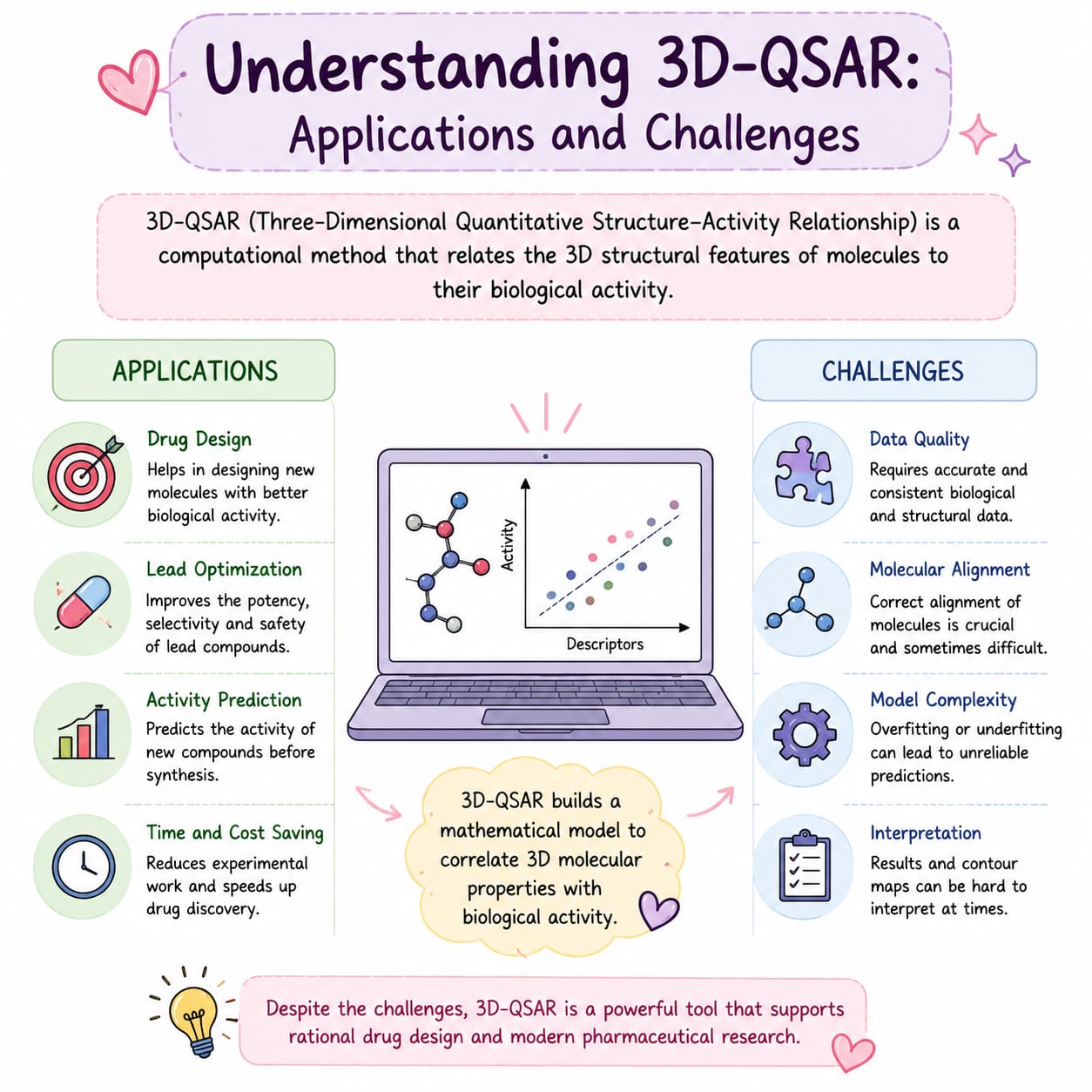
The process of discovering a new drug is both time-consuming and expensive. Scientists often need to synthesize and test hundreds or even thousands of compounds before finding a promising drug candidate. To make this process more efficient, computational techniques such as 3D-QSAR (Three-Dimensional Quantitative Structure-Activity Relationship) have become essential tools in modern medicinal chemistry.
3D-QSAR helps researchers understand how the three-dimensional properties of molecules influence their biological activity. By establishing a mathematical relationship between molecular features and biological responses, scientists can predict the activity of new compounds before they are synthesized, saving both time and resources
Future Perspectives
Recent advances in artificial intelligence, machine learning, and molecular modeling are enhancing the capabilities of 3D-QSAR. Integration with techniques such as:
Molecular Docking
Molecular Dynamics Simulations
Machine Learning Algorithms
Artificial Intelligence-Based Drug Discovery
is expected to improve prediction accuracy and accelerate pharmaceutical research.
As computational power continues to grow, 3D-QSAR will remain an important tool for designing safer and more effective medicines.
Follow us on Instagram
Follow us on Facebook
Visit us our Institutional Websites
https://lcit.edu.in
https://lcitbsp.edu.in
https://lcitcc.edu.in
https://lcitlaw.edu.in
https://lcitsop.edu.in
https://lcitcop.edu.in
