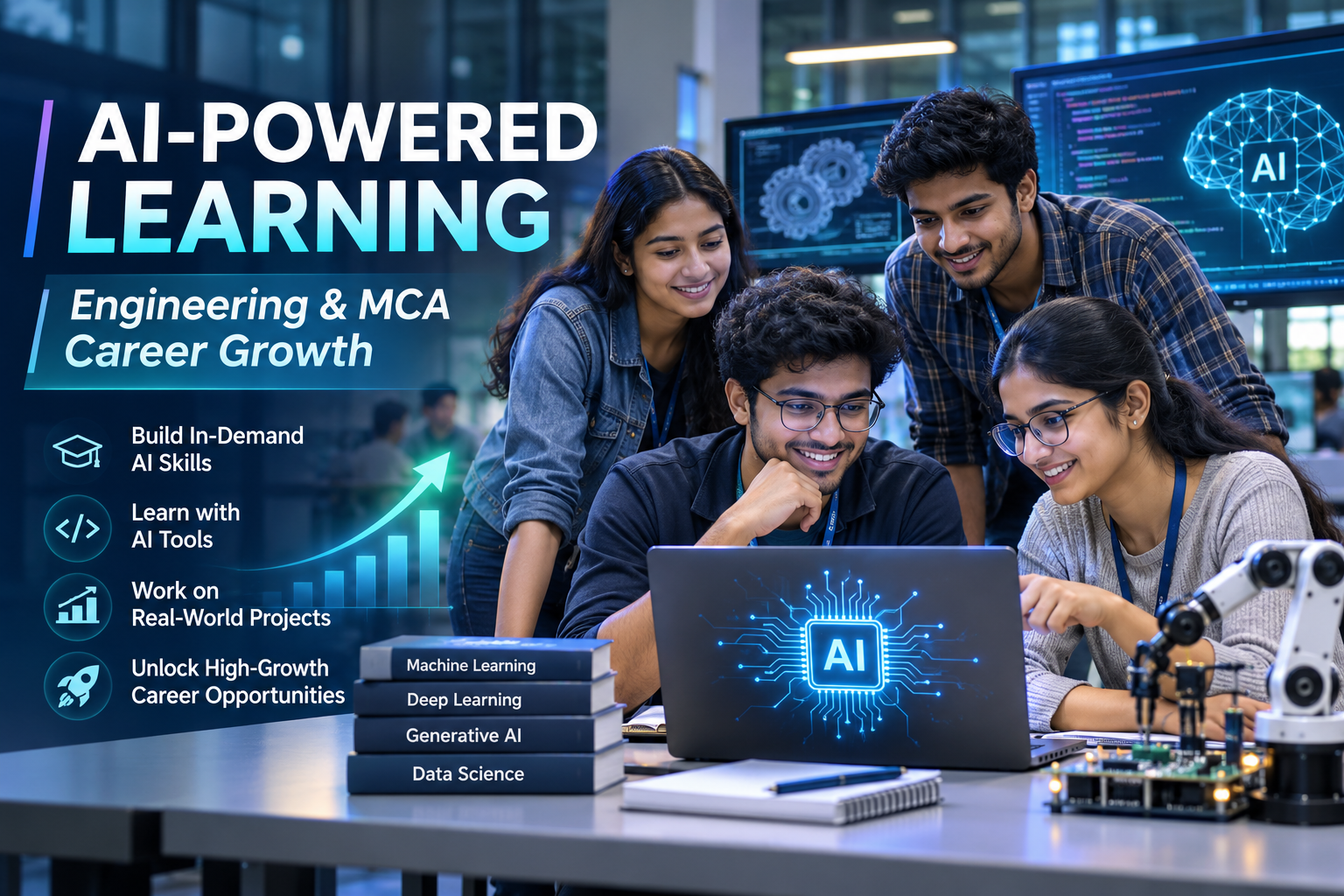
From Smart Classrooms to Smarter Careers: Why AI Skills Are Becoming Essential for the Next Generation of Engineers and IT Professionals
Introduction: The Future of Education Is Powered by AI
The world of technology is changing faster than ever. Artificial Intelligence (AI) is no longer limited to science fiction or advanced research laboratories. Today, AI is transforming how students learn, how engineers solve problems, how software is developed, and how industries recruit skilled professionals.
For students pursuing B.Tech, B.E., and Master of Computer Applications (MCA), understanding AI is becoming an important advantage for building a successful career.
Traditional classroom learning provides essential theoretical knowledge. AI-powered education can complement this foundation through personalized learning, intelligent coding assistants, virtual laboratories, automated feedback, and real-world problem-solving experiences.
The real opportunity is not simply learning how to use AI tools. It is learning how to think critically, solve complex problems, and build innovative solutions using AI technologies.
1. How Artificial Intelligence Is Transforming Engineering and MCA Education
Artificial Intelligence is introducing a new approach to technical education by making learning more interactive, personalized, and practical.
Personalized Learning Experiences
Every student learns differently. AI-based learning platforms can help students identify weak areas, practice difficult concepts, and receive explanations suited to their learning levels.
For example, an Engineering student struggling with Data Structures and Algorithms can use an AI learning assistant to understand concepts through examples and step-by-step guidance.
Similarly, an MCA student learning Python, Java, or database management can receive coding explanations, debugging suggestions, and practice exercises.
AI-Powered Programming and Software Development
AI coding assistants help students understand programming concepts, identify errors, generate test cases, and explore alternative solutions.
Tools such as GitHub Copilot, ChatGPT, and other AI-powered development environments can support learning in:
- Python, Java, C++, and JavaScript
- Web and mobile application development
- Database design and SQL
- API development and integration
- Software testing and debugging
- Cloud computing and DevOps
However, students must understand, test, and verify AI-generated code rather than depending on it blindly.
Smart Laboratories and Virtual Simulations
AI-supported simulations can help students explore engineering concepts before working with physical equipment.
Mechanical Engineering students can experiment with predictive maintenance, Electrical Engineering students can investigate smart energy systems, and Civil Engineering students can explore structural monitoring and intelligent construction technologies.
Virtual laboratories can be especially valuable when equipment, time, or resources are limited.
2. Why AI Skills Matter for Future Career Growth
The demand for technical professionals is changing across the global job market.
According to the World Economic Forum’s Future of Jobs Report 2025, AI and big data are among the fastest-growing skill areas expected through 2030. Technology-related careers such as AI and Machine Learning Specialists, Big Data Specialists, and Software Developers are among the roles projected to grow rapidly.
For Engineering and MCA students, this creates opportunities to combine traditional technical knowledge with emerging AI capabilities.
Companies increasingly value professionals who can understand business problems, analyze information, develop reliable software, and apply automation responsibly.
AI skills can help graduates compete for emerging roles, but successful employment also depends on fundamental technical knowledge, practical experience, communication, and continuous learning.
3. Emerging AI Career Opportunities for Engineering and MCA Graduates
AI and Machine Learning Engineer
Develops intelligent models and applications for prediction, classification, automation, and decision support.
Core skills: Python, mathematics, statistics, machine learning, and model deployment.
Data Scientist and Data Analyst
Collects, processes, and analyzes data to support business decisions and discover useful patterns.
Core skills: SQL, Python, statistics, Power BI, data visualization, and machine learning.
Generative AI Application Developer
Creates applications using large language models, conversational AI, retrieval-augmented generation, and intelligent automation.
Core skills: Python, APIs, databases, LLM fundamentals, evaluation, and application security.
AI-Enabled Software Developer
Combines software engineering fundamentals with AI-assisted development to build efficient, reliable applications.
Core skills: Java or Python, JavaScript, data structures, system design, Git, testing, and AI coding workflows.
AI and Cybersecurity Specialist
Explores intelligent threat detection, security analytics, anomaly detection, and automated incident investigation.
Core skills: Networking, Linux, Python, security fundamentals, and machine learning.
Robotics and Intelligent Automation Engineer
Develops systems that integrate sensors, controls, computer vision, and intelligent decision-making.
Core skills: Robotics, electronics, control systems, Python, C++, and computer vision.
Cloud and MLOps Engineer
Builds the infrastructure required to deploy, monitor, secure, and maintain machine learning applications.
Core skills: Cloud platforms, Docker, Kubernetes, CI/CD, model monitoring, and automation.
These roles require different levels of preparation. Some may be accessible through graduate-level projects and internships, while others require advanced specialization or professional experience.
4. AI Applications Across Different Engineering Branches
Artificial Intelligence is not exclusively for Computer Science students.
Computer Science and IT: Intelligent software systems, AI chatbots, automated testing, cybersecurity, and cloud-based AI applications.
Mechanical Engineering: Predictive maintenance, robotics, quality inspection, manufacturing automation, and digital twins.
Civil Engineering: Smart infrastructure, project risk prediction, structural health monitoring, and construction planning.
Electrical and Electronics Engineering: Smart grids, energy consumption forecasting, intelligent control systems, and fault detection.
Electronics and Communication Engineering: Signal processing, embedded AI, IoT devices, communication optimization, and computer vision.
MCA: AI-integrated enterprise applications, full-stack software development, intelligent database systems, business process automation, and data analytics.
The most valuable AI projects often combine knowledge from multiple engineering disciplines.
5. Essential AI Skills Every Engineering and MCA Student Should Develop
Students can build an AI-focused skill portfolio by developing capabilities in five areas.
Programming Fundamentals: Python, data structures, algorithms, object-oriented programming, SQL, and software engineering practices.
Mathematics and Analytics: Statistics, probability, linear algebra, data interpretation, and analytical reasoning.
Artificial Intelligence Technologies: Machine learning, neural networks, natural language processing, generative AI, computer vision, and responsible AI.
Development Tools: GitHub, Jupyter Notebook, VS Code, cloud platforms, APIs, and relevant AI frameworks.
Professional Skills: Communication, creativity, teamwork, logical thinking, project documentation, presentation skills, and adaptability.
A strong understanding of fundamentals makes it easier to learn new AI tools as technology evolves.
6. Real-World AI Projects Students Can Build
Practical projects are among the best ways to demonstrate technical ability to employers.
Some useful project ideas include:
- AI-Powered Student Learning Assistant: A chatbot that answers curriculum-related questions using verified educational materials.
- Smart Attendance Analytics System: A dashboard for identifying attendance patterns and generating academic reports.
- AI-Based Career Recommendation Platform: A system that suggests educational and career pathways based on student interests, skills, and preferences.
- Intelligent Inventory Management System: An application that forecasts stock requirements using historical sales data.
- AI-Based Crop Disease Detection: A computer vision project that classifies possible plant diseases from images.
- Smart Energy Monitoring Dashboard: A tool that analyzes electricity consumption and identifies abnormal usage patterns.
Students should build these applications with appropriate data permissions, privacy safeguards, model validation, and clear explanations of system limitations.
7. A Six-Month AI Learning Roadmap for Students
Month 1: Strengthen the Fundamentals
Focus on Python, SQL, Git, programming logic, and basic mathematics.
Month 2: Learn Data Analysis
Practice with Pandas, NumPy, data visualization, exploratory analysis, and real datasets.
Month 3: Understand Machine Learning
Learn supervised and unsupervised learning, model evaluation, data preparation, and introductory Scikit-learn.
Month 4: Explore Generative AI
Study prompt design, APIs, LLM applications, embeddings, and responsible AI practices.
Month 5: Build a Portfolio Project
Develop a complete application, test its functionality, document your work, and publish appropriate code on GitHub.
Month 6: Prepare for Industry Opportunities
Improve your resume, practice technical interviews, apply for internships, and demonstrate projects through a personal portfolio.
This roadmap is a starting point. Advanced AI engineering may require significantly more time, especially for mathematics, model development, and production deployment.
8. How Colleges Can Prepare Students for AI-Driven Careers
Engineering and MCA institutions can play an important role in preparing graduates for an evolving technology industry.
Colleges should consider integrating AI awareness across relevant subjects, establishing practical AI laboratories, supporting interdisciplinary innovation projects, and organizing industry-led workshops.
Hackathons, internships, collaborative projects, technical presentations, and mentorship can help students connect theoretical knowledge with professional expectations.
AI literacy should also include academic integrity, data privacy, bias, explainability, and the safe use of automated systems.
The goal is not to replace teachers with technology. It is to help educators deliver more effective learning experiences while students develop independent thinking and practical skills.
9. Will Artificial Intelligence Replace Engineering and IT Jobs?
AI is automating some repetitive tasks and changing how many jobs are performed. At the same time, it is creating demand for new skills and specialist roles.
A software developer may increasingly use AI tools for routine coding, but human expertise remains essential for understanding requirements, designing systems, evaluating risks, testing performance, and maintaining reliability.
Students should therefore approach AI as a powerful professional tool, not as a substitute for their own understanding.
The most resilient career strategy is to combine strong domain knowledge, AI proficiency, problem-solving ability, and continuous professional development.
Conclusion: Learn AI Today, Prepare for Tomorrow’s Career
Artificial Intelligence is creating an important turning point in Engineering and MCA education.
Students who develop AI literacy, strengthen their technical foundations, and complete meaningful projects will be better prepared to explore emerging career opportunities.
The future belongs not merely to those who can use AI tools, but to those who can apply knowledge creatively, solve meaningful problems, and develop trustworthy technology.
Your degree builds your foundation. Your skills create opportunities. Your ability to keep learning shapes your future.
Frequently Asked Questions
Is AI useful for students outside Computer Science?
Yes. AI has practical applications in Mechanical, Civil, Electrical, Electronics, and other engineering disciplines.
Can MCA students pursue AI careers?
Yes. MCA students with suitable programming, mathematics, data analytics, and project experience can pursue AI-related software development and specialist opportunities.
Which programming language should beginners learn for AI?
Python is a practical starting point because of its accessible syntax and extensive AI and data science ecosystem.
Can AI skills guarantee a high-paying job?
No. AI skills can improve career options, but hiring and compensation depend on experience, technical ability, market conditions, location, and employer requirements.
Should students learn programming even when AI can generate code?
Absolutely. Programming knowledge helps students identify errors, assess security, optimize performance, and build reliable software independently.
Final Message for Students:
Learn AI. Build Projects. Strengthen Your Skills. Shape Your Career.
“Don’t just prepare for the jobs of today. Develop the knowledge, skills, and creativity to solve the problems of tomorrow.”
Follow us on Instagram
Follow us on Facebook
Visit us our Institutional Websites
https://lcit.edu.in
https://lcitbsp.edu.in
https://lcitcc.edu.in
https://lcitlaw.edu.in
https://lcitsop.edu.in
https://lcitcop.edu.in
