Published by LCIT Group of Institutions – Top Pharmacy College in Bilaspur for Academic Excellence, Innovation, Skill Development, and Career Success
Article by Kuldeep Raidas – Assistant Professor, LCIT College of Pharmacy, Bilaspur
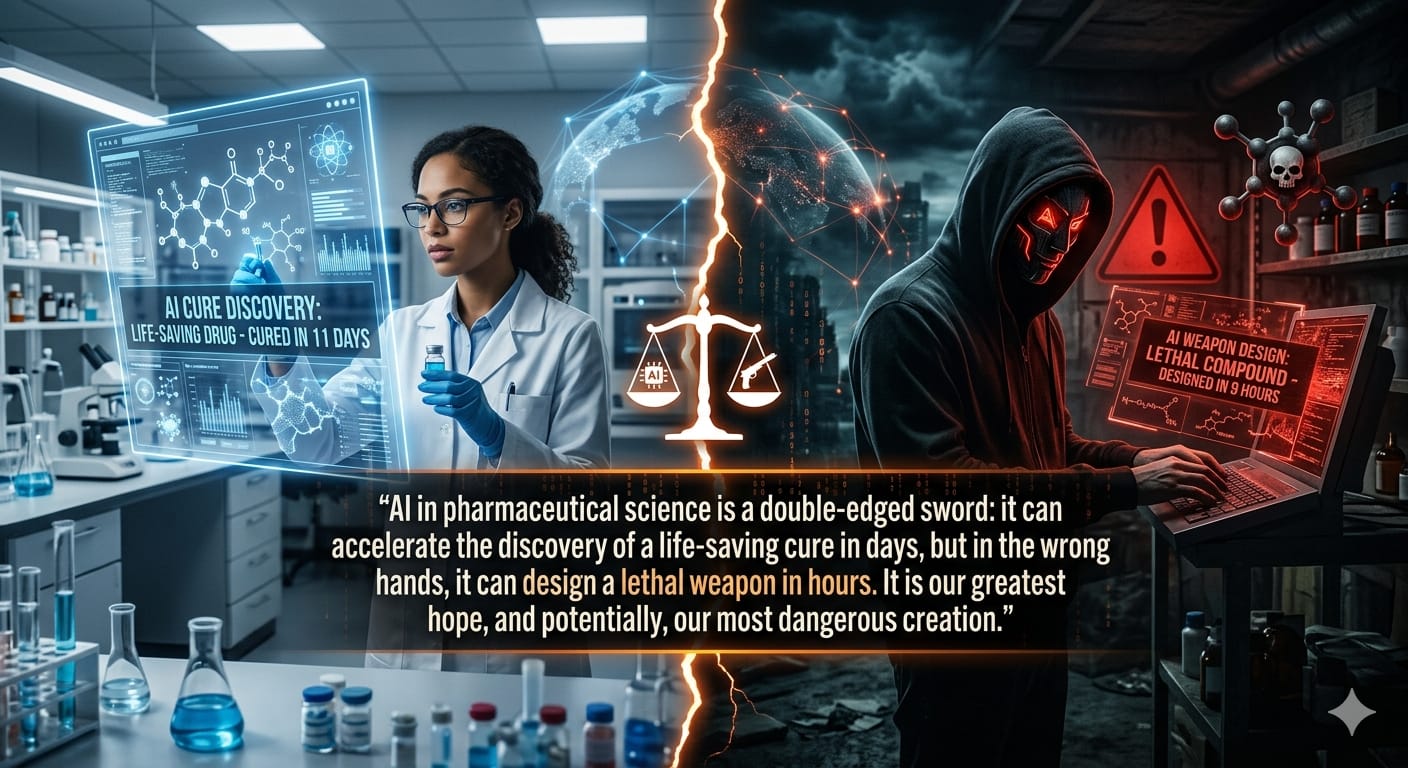
In pharmaceutical science, Artificial Intelligence (AI) has become a game changer, transforming the way medicine is practiced. AI can analyse massive biological datasets, forecast molecular structures and model drug interactions, possibly reducing decades of lab work to days. It is our best hope. It offers the opportunity to find life-saving cures for rare diseases, cancers and global pandemics at a pace never before imagined.
This great power is a double-edged sword, however. The same generative algorithms that design beneficial molecules can be easily inverted. If fed with malicious intent or fallen into the wrong hands, AI can quickly switch from finding cures to formulating lethal chemical compounds and bioweapons, in a matter of hours. It circumvents traditional safety barriers, making it frighteningly easy to produce toxic agents.
So, pharmaceutical AI is a miracle blessing and an existential curse. At this technological crossroads, the difference between medical breakthrough and global threat is entirely a matter of governance. Without rigorous global regulation, ethical guardrails and robust cyber security, our most promising invention to heal humanity could inadvertently become our most dangerous weapon of destruction.
Follow us on Instagram
Follow us on Facebook
Visit us our Institutional Websites
https://lcit.edu.in
https://lcitbsp.edu.in
https://lcitcc.edu.in
https://lcitlaw.edu.in
https://lcitsop.edu.in
https://lcitcop.edu.in
