By Yashasvi Sharma
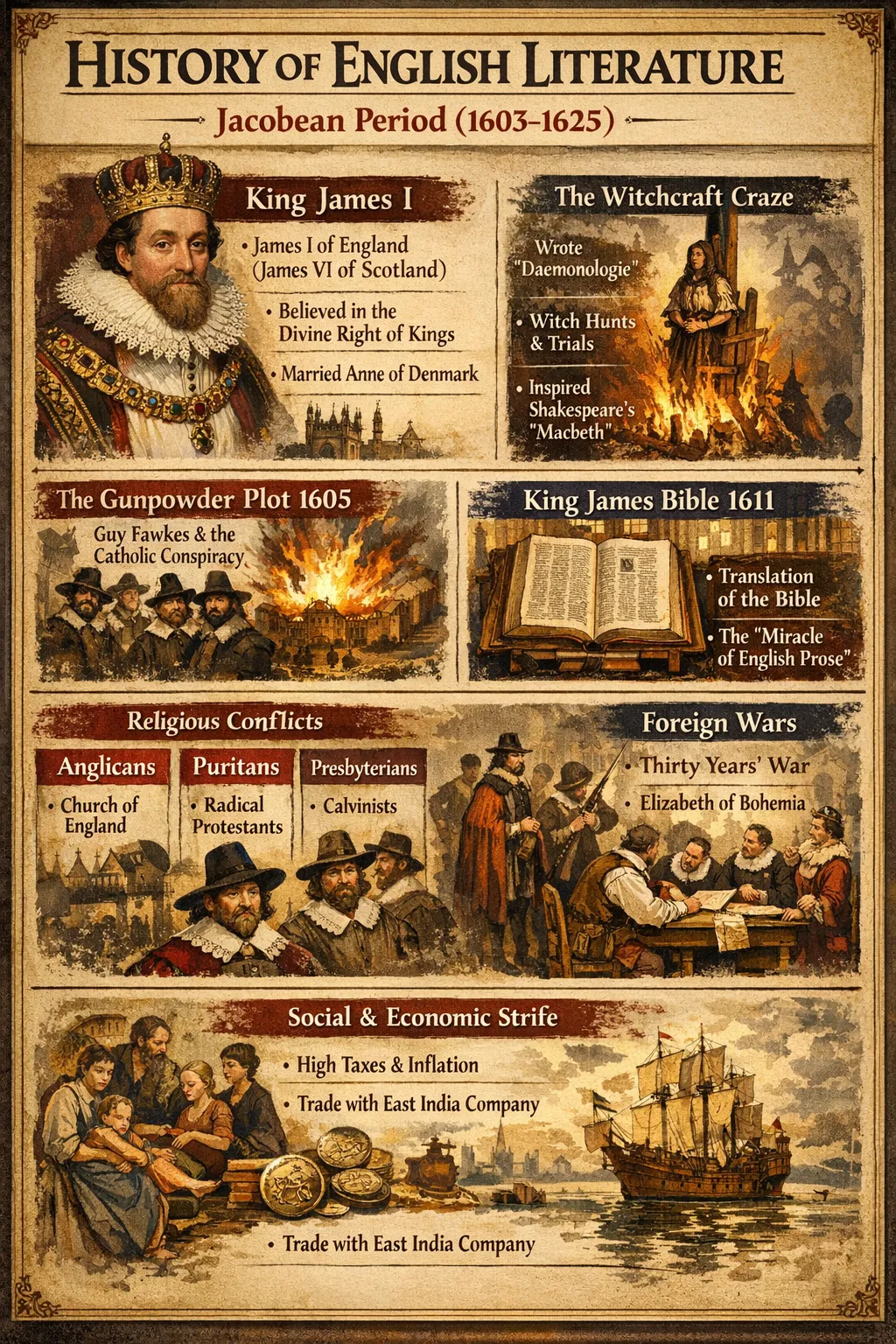
The Jacobean Period refers to the reign of King James I in England. It is marked by political tension, religious conflict, and significant literary development.
⸻
About King James I
- James I of England (also James VI of Scotland) became king of England in 1603.
- Established the Stuart Dynasty in England.
- Believed in the Divine Right of Kings (power comes directly from God).
- Had little interest in women; preferred male companionship.
- Married Anne of Denmark in 1589.
⸻
Interest in Witchcraft & Literature
- Became interested in witchcraft after visiting Denmark.
- Strongly believed witches were dangerous and persecuted them.
- Wrote Daemonologie (1597).
- This book influenced William Shakespeare in writing Macbeth.
⸻
Major Political Events
- Gunpowder Plot (1605):
• Led by Robert Catesby.
• Catholics planned to blow up Parliament.
• Guy Fawkes was caught.
• Celebrated as Bonfire Night on 5th November in Britain. - Dissolved Parliament in 1611:
• Ruled without Parliament for years.
• Increased tension due to his belief in absolute monarchy.
⸻
Foreign Policy & War
- England indirectly involved in the Thirty Years’ War.
- His daughter Elizabeth of Bohemia married a Protestant prince.
⸻
Religious Developments
- King James Bible published in 1611.
- Replaced the Bishops’ Bible.
- Result of Hampton Court Conference.
Translation Process:
- Work began in 1607.
- 47 scholars divided into 6 groups.
- Centers: Westminster, Oxford, Cambridge.
- Supervised by Lancelot Andrewes.
- Not a new Bible, but a revised version.
- Known as the “Miracle of English Prose”.
⸻
Religious Groups & Conflict
- Anglicans
• Followed Church of England.
• Supported king and bishops.
• Maintained some Catholic traditions. - Presbyterians
• Calvinists.
• Opposed bishops.
• Wanted church governed by elders. - Puritans
• Wanted to purify Church of England.
• Opposed rituals and Catholic influence.
• Believed in independent congregations.
• Faced opposition from James
Social & Economic Conditions
- Economic problems due to:
• Heavy taxation
• Inflation
• Poor harvests - King’s extravagant spending worsened financial crisis.
- East India Company expanded trade with India and Asia.
